📸 Sharp photos can still feel random. That is the quiet frustration of beginner event photography: the camera works, the focus lands, the exposure is fine... but the gallery still feels like a bag of loose marbles. Framing is what gives those marbles a bowl.
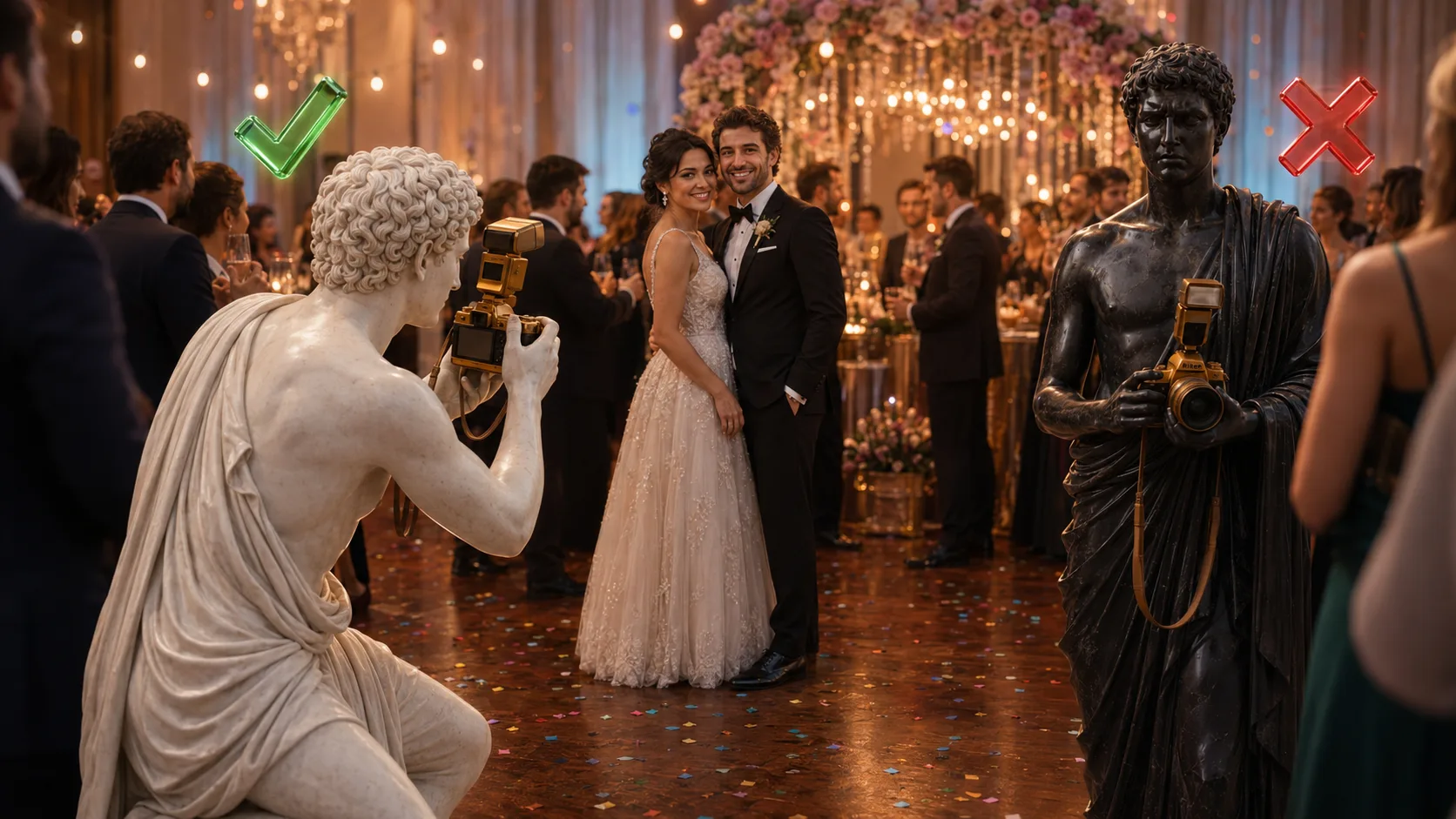
Intentional doesn't mean complicated. Sometimes one small shift — like dropping to one knee — is enough to turn a snapshot into something that holds attention.
The Frame Is A Doorway
Think of the frame like a doorway. If the doorway is crooked, cluttered, or pointed at nothing, the viewer hesitates. If it is clean, they walk straight into the moment. At events, this matters because the room is always busy. People, bags, glasses, hands, signs, exit lights — everything wants to steal the eye.
Do this: before you lift the camera, decide the one thing this photo is about. Then move your feet until the frame protects that thing.
1. Pick The Hero Before You Shoot
Every event photo needs a hero. It might be a face, a laugh, a hand on a shoulder, the cake, the speaker, or the couple walking through the room. The beginner mistake is trying to honour everything at once. When everything is important, nothing is.
- choose one main subject
- remove or hide the loudest distraction
- leave enough space for the moment to breathe
- check the edges before pressing the shutter
2. Use Edges Like A Fence
The middle of the frame is where most beginners stare. The edges are where the mess sneaks in. A half-face, a chopped hand, a bright sign, an empty chair — these little things make the image feel careless even when the subject looks good.
Be careful: a photo can be technically correct and still feel cheap if the edges are noisy. Good framing is often just quiet housekeeping.
3. Move Your Feet Before You Blame Your Settings
Settings change brightness. Your feet change the story. One step left can hide a bin. One step down can make the speaker feel powerful. One step closer can turn a random crowd shot into a human moment. This is why composition is not an abstract art word. It is a field decision.
- look for the moment
- name the hero
- scan the background
- move until the mess gets quieter
- then shoot
A Simple First-Gig Rule
If you feel overwhelmed, use this rule: one hero, clean edges, then shoot. That is enough to make a beginner gallery feel more intentional. The deeper craft — layering, leading lines, rhythm, sequencing, and story coverage — comes later. First, give the viewer somewhere clear to stand.
Want to go deeper? Event Photography 101 turns these little field decisions into a full working system, so your gallery stops feeling accidental and starts feeling held together.