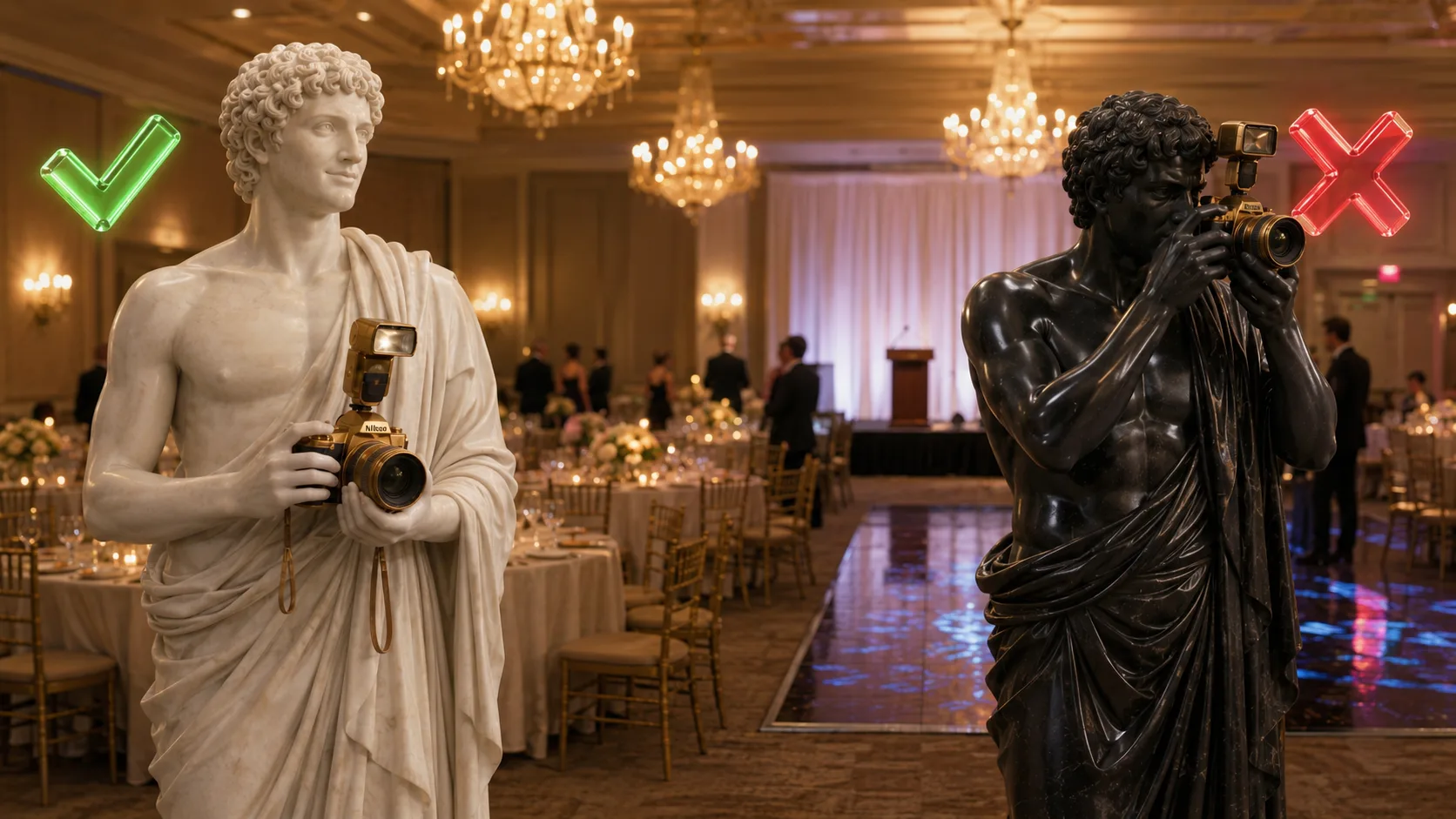
👁️ Every venue gives you its answers before you raise the camera — but only if you ask. Most beginners walk in, start shooting when the guests arrive, and spend the rest of the night reacting to problems they never saw coming. The pros read the room first. Sixty seconds of scanning before anyone arrives tells you almost everything about how your night will go.
The 60-Second Room Read
Walk in early. Before you unpack a single thing, look up, look around, and answer four questions. Those four answers decide your entire strategy for the night:
- 👀 What colour and height is the ceiling? — this decides whether bounce flash is even possible. Dark or coloured ceilings mean a different strategy.
- 🧱 Are there neutral walls nearby? — your bounce surfaces. No neutral walls, no clean bounce.
- 💡 What is the ambient light actually doing? — warm, ugly, mixed, or beautiful? Decide how much of the room you want to keep.
- 📍 Where will the key moments happen? — pre-visualise where you'll stand for speeches, cake cutting, and the first dance.
Do this: walk the empty room with your camera before guests arrive. Shoot test frames. Check the histogram. Lock your white balance. When the room fills, you are not fumbling — you are confident, because the room already told you what it would do.
Let the Room Cast Its Vote
The biggest beginner mistake is forcing a strategy the room is fighting. You heard bounce flash is soft, so you bounce — into a black ceiling, off a red wall, outdoors. The room gets a vote, and sometimes the room says no. Listen to it. A bad bounce is worse than deliberate direct flash. Read the surfaces first, then choose your look on purpose.
Map the Room, Then Move With Purpose
Once you've read the room, you stop improvising under pressure. You know your bounce surfaces, your clean backgrounds, and your key positions. When the speeches start, you are already where you need to be — not elbowing through a crowd to find an angle. Reading the room is how a nervous beginner starts moving like a pro.
That is the foundations habit that carries every other domain: read the room first, let it vote, then move with purpose. For the full system — how room-reading connects to flash strategy, framing, and the eight essentials — pair this with the Complete Beginner's Guide and grab Event Photography 101. 📘