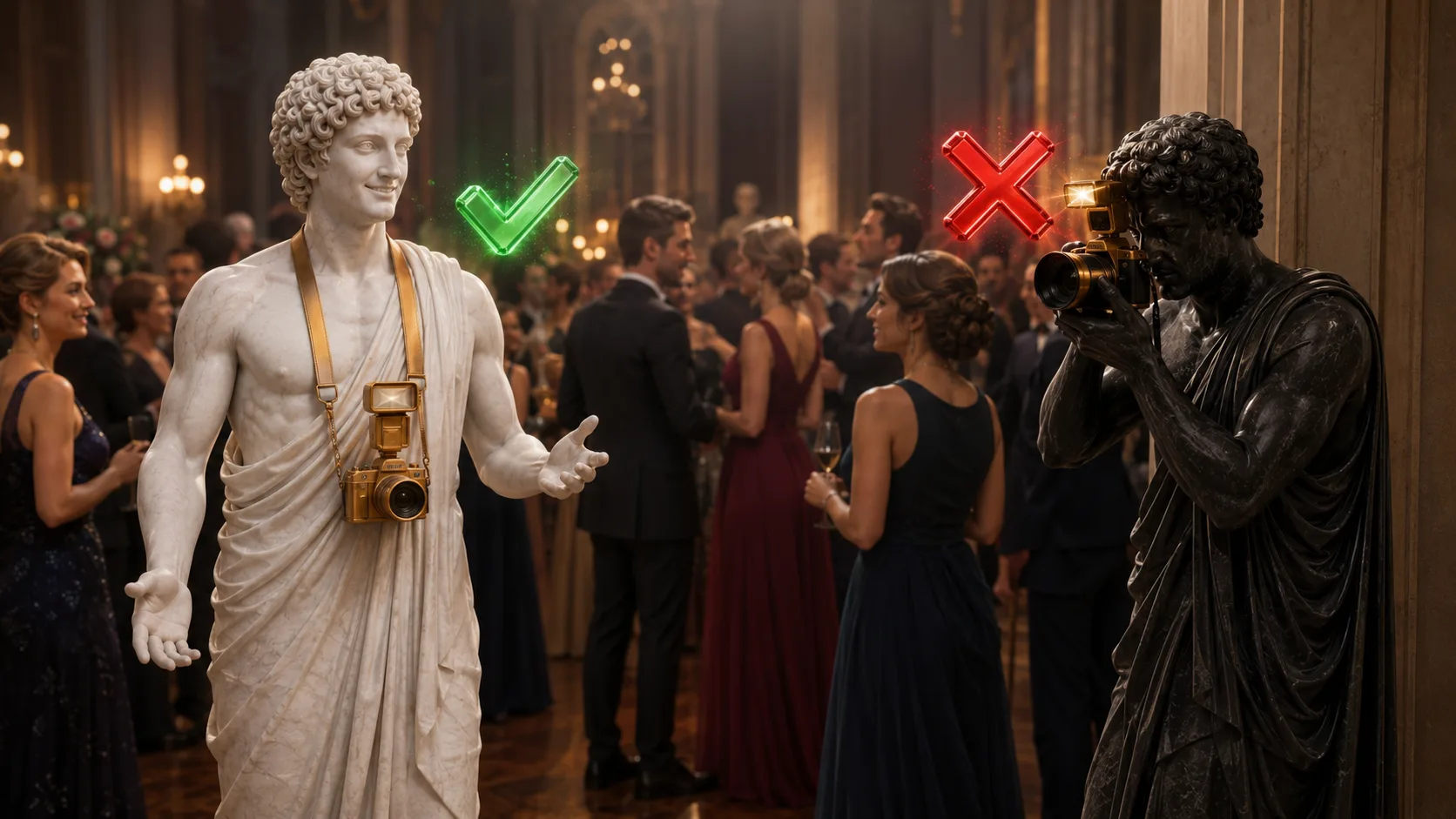
Posing real people is not about rigid positions. It's about giving them something natural to do — then catching the moment they forget the camera exists.
Confidence Is a Skill, Not a Personality
If you feel the flutter before walking into a room of strangers, here is the genuinely good news: confidence is not a personality trait you either have or lack. It is a practiced skill — preparation plus muscle memory. People skills are mostly a script you can rehearse until they are automatic. Act grounded, and the feeling tends to follow.
Before you enter any room: stand tall, drop your shoulders away from your ears, take two slow breaths. Your physiology talks to your psychology and to the room at the same time — open body language signals safety to your subjects and to yourself.
Your Face Sets the Weather
The single most useful idea in this whole field fits in one sentence: your face sets the weather. Everything else here is a footnote to that line.
Long before they hear a word you say, guests read your posture, your shoulders, the set of your jaw. A tight face spreads tension like a cold draft; a soft, settled face lowers the pressure in the whole space. When you walk in calm, they borrow your calm — which is why a photographer who feels nervous but stays steady often produces warmer frames than one who feels nothing and radiates chaos.
This is regulation, not charisma. You are not required to be the loudest or funniest in the room; you are required to be the steadiest. Stoic, even. Confidence on the job is a decision you make about your face and your shoulders, repeated until it stops costing effort.
Safety Before Smiles
If you remember one phrase from this guide, remember this: safety comes before smiles. Smile is the output of safety, never the cause of it. You cannot command a genuine expression from someone who does not feel safe — you can only create the conditions where one arrives on its own.
The beginner mistake is understandable: the clock is running, you are nervous, so you shove a camera at a stranger and bark "smile!" But a nervous guest does not need a lens in their face — they need calm attention. Let them feel they are in safe hands before you raise the camera, and the smile arrives on its own. Skip it, and you are photographing a performance.
A guest who feels safe gives you something genuine. One who feels cornered gives you a performance. Only one of those ages well in a portfolio — and in the memory of the person in it.
The Four Silent Communicators
Before people can trust you, they read you. Your etiquette sets the tone of every interaction through four silent signals — and getting them right costs nothing but attention. Most photographers never think about these deliberately... which is exactly why the ones who do stand out instantly.
- 🌤️ Posture — open, upright, relaxed shoulders. Stand as if you are genuinely glad to be exactly where you are.
- 🤝 Gestures — calm and open-handed. Slow your movements a beat and watch the room relax with you.
- 😊 Facial expression — soft and kind. When stress climbs, consciously soften your face first; the interaction follows it down.
- 👁️ Eye contact — a dial, not a switch. Meet them, release, return. Let the camera take their face; give them your eyes when they need to remember a human is there.
Run the four before you approach. Upright posture, calm hands, soft face, eyes meeting theirs. This tiny checklist is worth more than any pose you will ever learn — because it is the foundation every pose is built on.
Tonality & Permission-Based Phrasing
When you do speak, two things matter as much as the words: the music of your voice, and how you frame the ask.
Keep a lower, grounded pitch — when stress rises, the voice rises with it and directions start ending like questions, leaking doubt into your subject. Let directions land as statements. Hold a steady, unhurried pace; a measured beat tells a nervous guest the moment is under control. Weight the action word — "Turn a little this way" — then spend your emphasis after the shutter on reassurance.
EP101 teaches permission-based phrasing over hard commands. Instead of "Stand there," soften it: "Can I get you to stand here for me?" You are not weaker for asking — you are more powerful, because you handed the subject a small measure of control, and a subject who feels in control relaxes.
The two magic words after every shutter: "Perfect." Said warmly and right away, it does more for a subject's expression than any pose adjustment. Most people are bracing for criticism — deliver the opposite, on loop.
The 7-Step Warmth Framework
Tie all of the above together and you get a repeatable recipe for warmth — the seven steps EP101 uses on every job, walked through consciously until it becomes automatic. The loop, in one breath:
- Enter like you are here to serve.
- Read the room and match its energy.
- Start with etiquette — run the four.
- Build rapport with tiny moments of chemistry.
- Guide with permission, never command.
- Use your lens instinct and move early.
- Meet tension with empathy instead of bulldozing it.
Deliberate warmth is a free advantage. Run this loop and you will outperform most working photographers on any given night — not because it is complicated, but because almost nobody bothers to be deliberate about warmth. It costs nothing and almost no one does it. That is your edge.
The Script for Introverts & Anxious Photographers
Everything above assumes you can show up and be steady. But what if showing up is the hard part? Good news: some of the best event photographers in the world are exactly like you.
The reframe that makes this career possible for introverts: event photography is social-adjacent, not social. You do not need to be the life of the party — you need to be reliably professional and good at noticing. You are capturing moments that happen, not running the evening, and observation is an introvert's home turf. The anxious photographer's superpower is the script — no clever conversation required, just a loop you rehearse until it is automatic:
- Approach — friendly eye contact, neutral smile.
- Ask — "Can I grab a quick photo of you?"
- Direct — one concrete line: "Turn slightly toward your friend, and look right here."
- Thank — "Great, thank you."
- Move on. That is the entire interaction.
Keep one more saveable people-skills reference close before the nerves spike. Panic shrinks your warmth; a simple hospitality checklist gives it somewhere useful to go.
Argue with imposter syndrome using data. Imposter syndrome shows up right before you start, when you measure your behind-the-scenes against someone else's highlight reel. The antidote is not more feelings — it is a proof list: photos delivered, compliments banked, clients who booked you again. Point the inner critic at the receipts, not at your nerves.
The Camera-as-Task Method
The phrase "awkward behind the camera" almost always means one thing: you are self-monitoring — worrying about how you look while the shot happens without your attention. Self-monitoring is the thief of presence. The fix is not more confidence — it is a better task.
Give yourself a job so concrete there is no room left for self-surveillance. Pre-decide what you will photograph — arrivals, candids, details, portraits — and use repeatable compositions and prompts so you are not improvising from scratch. A simple version for a networking event: aim for two photo moments per group — first a wide candid while people talk (you observe, not direct), then a quick portrait where you only ask them to face you and smile.
Awkwardness dissolves for a simple reason: you are no longer the subject of your own attention — the camera and the task are. A photographer absorbed in the work reads as confident to everyone in the room, whether or not confident is what they are feeling. The feeling follows the action.
Awkwardness is a symptom of self-monitoring. The cure isn't more confidence — it's a better task. Get specific about what you're shooting, and the awkwardness runs out of oxygen because there is no attention left to feed it.
Quick-Reference People-Skills Checklist
- 🌤️ Set the weather: soften your face and settle your shoulders before you enter any room.
- Safety before smiles — give calm attention before you raise the camera. Enter to serve, not to perform.
- Read the room and match its energy. Run the four: upright posture, calm hands, soft face, balanced eye contact.
- Speak low, steady, and clear. Use permission-based phrasing and say "Perfect" right after the shutter.
- Trade small talk for a script: approach, ask, direct, thank, move on.
- Pre-decide what you'll shoot — a clear task kills awkwardness. Keep a proof list so imposter syndrome meets evidence.
That is people skills as a system: set the weather, create safety, run the four, guide with permission, trade anxiety for a script. Run that loop and your galleries start carrying genuine expression instead of performed smiles. When you want the fuller field system — the exact phrasing for the 7-step warmth framework, the difficult-client scripts, and the reading-a-room playbook — Event Photography 101 takes these principles the rest of the way. 📘