Flash is where most beginners panic — but the fix is simpler than you think. Start with one reliable approach and build from there.
The Big Shift: Posing Is Hosting You Can See
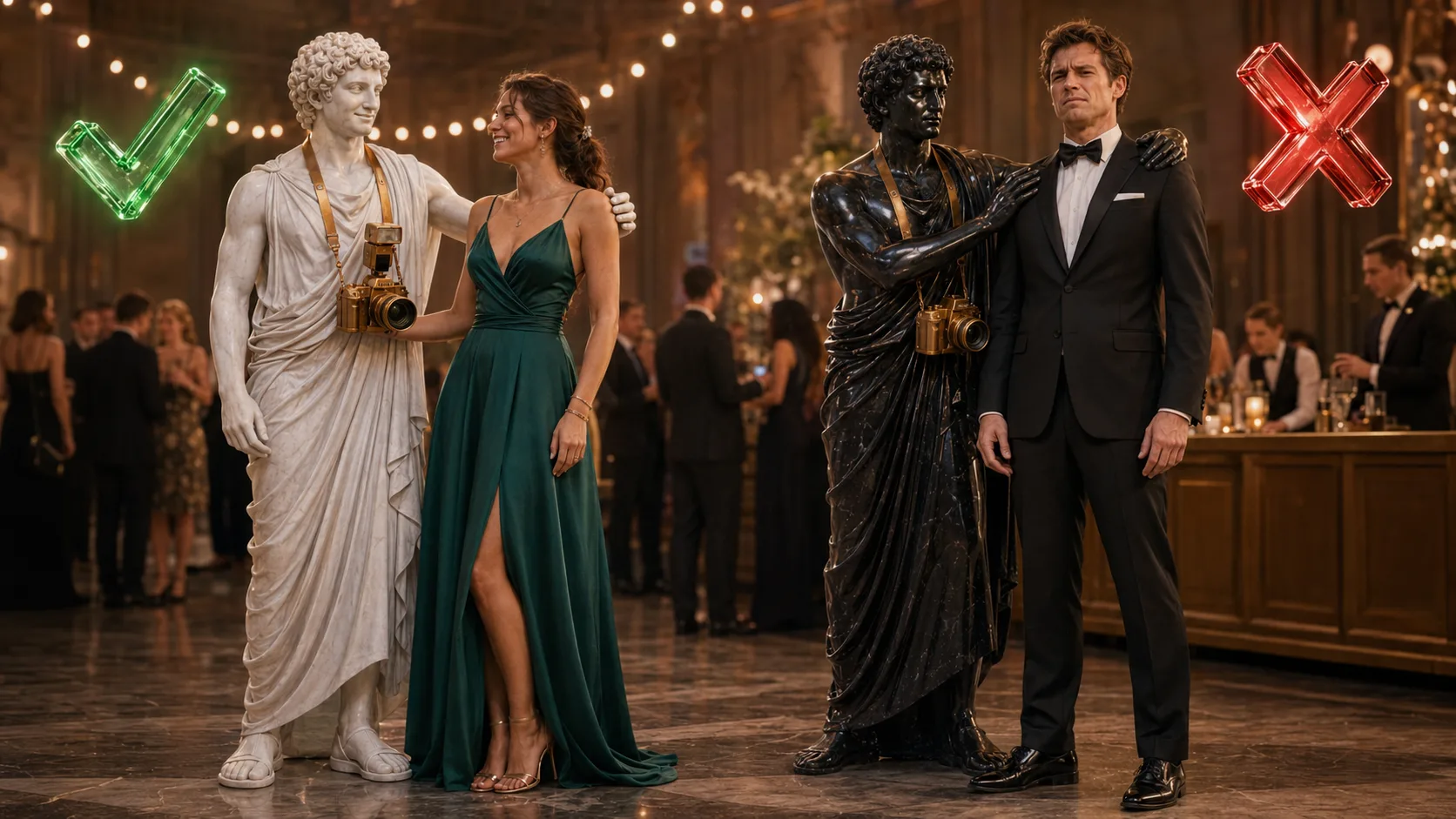
Most posing guides treat the body like a mannequin — a list of angles to force a stranger into. That's why they fail at real events. Your subject isn't a model; they're a guest who is nervous, self-conscious, and convinced they're unphotogenic. Posing is not the first move. Warmth is. Get the human settled, then shape the body.
Posture before pose. Chest up, shoulders down, weight on one foot. Once the body is open and grounded, almost any direction you give lands well. Skip this and every pose underneath it looks stiff.
The 4 Principles That Make Any Pose Work
Before you memorize a single pose, understand why a pose works. EP101 leans on four foundational rules. Internalize these and you can invent poses on the fly instead of copying a Pinterest board like it's gospel.
- Perspective (close vs. far) — whatever is closer to the lens appears larger. That's not a flaw, it's a tool: angle their best features toward the camera and nudge the rest away, sculpting with distance instead of luck.
- Body language (open vs. closed) — open posture invites connection; closed posture puts up walls. Most beginners overestimate how open their subject looks, so nudge for a touch more — chest up, shoulders down, weight forward.
- Asymmetry (flat vs. shifted) — even weight on both feet reads as static and a little dead. Shift weight to one foot and the body finds natural curves, the hip drops, the whole frame comes alive. Flat is the enemy of flattering.
- Emotion (posed vs. felt) — a technically perfect pose of a guarded face is still a guarded face. The pose is the scaffolding; the feeling is the photograph.
The one principle beginners skip: asymmetry. The instant you see a flat, even stance, move the weight to one foot. You'll watch the pose come alive before you've said another word.
The Sexy Six: Build a Pose Fast
Freezing up and running out of ideas is the most common posing problem — and it has a cure. The Sexy Six is a chronological, step-by-step system for building a dynamic pose from scratch. Adjust even one of these six levers and you multiply your variations... no panic, no pretending you suddenly became Annie Leibovitz.
- Turn the shoulders about 45° away from the camera
- Shift the weight onto the back foot
- Cross or bend the free knee
- Shimmy the shoulders — drop one slightly
- Give the hands a task (glass, hip, lapel, tie)
- Direct the chin, head, and eyes
Do this: once the Sexy Six is set, change only the hands and the gaze for your next five frames. The pose stays flattering, the variety feels endless — and you stop blanking out mid-shoot.
The Cake: A 3-Layer Framework for Couples
For couples — or any pair you want to photograph with warmth — EP101 uses a cake metaphor. You build connection layer by layer, never starting with the sparkler. Skip a layer and the whole thing collapses.
- 🎂 The Base — a classic foundation pose. Your reliable scaffolding. Nothing dramatic yet; just two people grounded and well-framed.
- 🧁 The Icing — two connection points (a hand on a waist, a forehead leaning in) that make strangers look like they actually like each other.
- ✨ The Sparkler — movement that turns a portrait into a moment: a walk, a dip, a laugh. Always last.
Why the order matters: beginners reach for the dip first because it's dramatic. But a dip with no base reads as awkward gymnastics. Build the sponge, spread the icing — then light the sparkler.
Posing Real, Awkward People
Here's the part most posing guides skip: your subjects are not models. They're nervous, they think they're unphotogenic, and your job is to lower their emotional barriers before you ask them to move. Beginners make people stiff with cold commands — then blame the subject. Warmth first. Directions second. 🤝
Mirror the pose yourself
Do the pose yourself. Your body speaks louder than your mouth ever could, and mirroring lowers tension and builds trust almost instantly — people stop guessing at what you mean and relax by simply copying you. Yes, you'll feel silly for a second. That silliness is exactly what makes them comfortable.
Give them evidence
Sometimes people don't need encouragement — they need proof. Give them one simple flattering pose, capture it in good light, then immediately show them how good they look. The moment a nervous person sees themselves looking like a model, their tension melts — and the next frame gets dramatically better.
Common Mistakes & Quick Fixes
You'll see these at almost every event. The good news: each one has a fix you can apply mid-frame, before the subject even knows something was off. 📸
- The police-lineup look — everyone faces the camera flat with no variation. Fix it by turning a few people 45° away, dropping a shoulder, changing who looks at the lens. Variation separates a portrait from a lineup.
- Over-directing until guests freeze — talking people through every millimetre of a pose is how you make them stiff. Give a clear prompt, then stop directing and start a conversation. Shoot the reaction. The best pose is often the one you never explicitly asked for.
- Dead hands — arms hanging limp read as awkward. Always give the hands a job: hold a glass, rest on a hip, adjust a lapel. Busy hands look natural; empty hands look lost.
Quick rule for groups: fight the flat line. Stagger heights with steps, chairs, or risers; build outward from the central VIP or couple; create small sub-groups of two or three; and always capture a candid toast or laugh after the formal frame.
The Quick-Reference Posing Checklist
- Posture before pose: chest up, shoulders down, weight on one foot.
- Turn the shoulders 20–45° away and shift weight to create asymmetry.
- Give the hands a task — a glass, a hip, a lapel, a tie.
- Couples: build base → icing → sparkler. Never the sparkler first.
- Mirror the pose yourself before you describe it — warmth first, directions second.
- Groups: stagger heights, build from the VIP, then shoot the candid moment.
That's posing as a map: posture, the four principles, the Sexy Six, the cake, and the awkward-human tactics. Run that loop on every subject and your frames stop looking like police lineups and start looking like portraits. When you want the fuller system — the exact verbal cues for each Sexy Six lever, the full couples flow, and the group-staging walkthroughs — Event Photography 101 takes these ideas the rest of the way. 📘