Business skills are what separate photographers who shoot events from photographers who get paid properly for them. The carousel below covers the essentials.
💰 Pricing Strategy: Value Before Price
The most important thing to understand about pricing is that it is not just a number — it is a signal. It tells clients how to perceive you before they ever see a photograph. Underprice yourself and you attract clients who treat your time as a disposable commodity. Price with confidence and you attract clients who respect the work and the person behind the camera. Pricing is the single biggest filter you have for deciding who you work with.
EP101 teaches a technique called the ugly price anchor. Build an intentionally expensive top-tier package, priced so high you do not realistically expect anyone to buy it. It is not there to sell — it is there to shift the client's frame of reference. Sitting beside that premium number, your middle-tier packages suddenly feel like an attainable luxury rather than a price to be haggled down. The anchor does the psychological work for you.
Never discount without a trade-off. If a client cannot afford a package, the worst move is to simply drop your price — that starts a race to the bottom and trains every future client to negotiate. Change the terms instead: remove hours, cut a deliverable, or trade a modest discount for something valuable to you, like a video testimonial. The client feels heard; your worth stays intact.
📦 Building Packages That Sell Themselves
Packages beat hourly rates because they give clients something concrete to choose between. Build them around deliverables, not hours — a four-hour event is never just four hours of work. Culling, editing, travel, and delivery all live in the shadow of that number, and pricing by the shooting hour is how you systematically undercharge.
- 🥉 Essential — core coverage plus an edited gallery
- 🥈 Premium — more coverage, more edits, a highlight reel or expanded gallery
- 🥇 Premium Plus — all-inclusive, priority editing, extended rights, second-shooter add-ons
- ➕ Add-ons — layer à la carte items on top. Never rebuild your core packages per inquiry.
Do this: build three tiers and an ugly anchor. Let the anchor make the middle tier look reasonable, and let the middle tier be where most clients land. Pricing becomes a choice, not a negotiation.
✍️ Contracts: Your First Line of Defense
Never shoot a paid event without a signed contract. A contract is not a sign of distrust; it is a sign of professionalism, and clients who bristle at signing one are telling you something important about the relationship ahead. At minimum it must lock down the scope of work, deliverables, timeline, payment schedule, usage rights, and cancellation policy — every clause exists because a photographer somewhere learned the hard way it was needed.
The clause that protects your margins over time is the change policy: any deviation from the agreed scope requires a written addendum with updated pricing. When the client asks for just one more hour, just a few more edits, two weeks before the event — the answer is never no. The answer is yes, here is what that costs, and here is the addendum to sign.
The change-policy sentence: "Happy to do that — here's what it adds to the package, and here's the addendum to sign." Said warmly, it protects your time without making you sound cold.
🪤 Scope Creep: How It Kills Your Profit
Scope creep is the slow expansion of what a client expects beyond what you agreed to, and it rarely arrives as a single dramatic demand. It arrives as a dozen small requests, each reasonable on its own... until you realise you are working for free on a job you already finished.
Cap revisions — two rounds is a healthy standard — and present an estimate plus a signed addendum before you lift a finger on anything beyond the agreement. Framing the revision cap as a quality decision helps clients accept it: they are not being limited, they are being protected from a worse final product.
Avoid: doing the extra work first and sending the invoice after. Once the edit is done, the client has no reason to sign anything. Estimate and addendum come before the work — always.
⚖️ Difficult Clients: Filter Before You Book
The best way to handle a difficult client is to never book them. A 5–10 minute pre-booking call reveals more about how the relationship will feel than any email thread ever could. If a demanding client is already booked, your options narrow to four: over-deliver as a loss-leader to protect your reputation, subcontract the event, refer them out with a goodwill gift, or — in serious cases — refund and walk away. Your sanity and reputation are worth more than a single fee.
🎯 The Two Questions That Define Success
Good communication is not a soft skill here — it is the difference between a client who refers you to ten friends and one who quietly never books you again. Start every engagement with two crucial questions: What do you call a successful event photography service? and What do you call a successful final gallery?
These two questions set the exact goalposts for the entire job. A status-driven host and a purpose-driven host will answer them very differently — and hearing that difference before the event lets you serve each one correctly, instead of guessing what success even looks like.
Ask early: "What does success look like to you?" Listen for whether they talk about image and perception (status) or people and connection (purpose). Let that answer shape which moments you prioritise.
⚙️ The 6-Step Edit & Delivery Workflow
EP101 teaches a predictable six-step loop that moves you from the memory card to a delivered gallery without the chaos that wastes hours and erodes quality:
- Download & back up — two local copies plus cloud before anything else.
- Cull — kill the duplicates and near-misses fast. The gallery is built by what you remove.
- Edit — batch the foundation: exposure, white balance, tone.
- Polish the last 20% — the hero frames that carry the whole gallery.
- Export — correct sizes, sharpening, and naming.
- Deliver — communicate the turnaround early. Delivering early delights; delivering late without a word erodes every bit of goodwill you built.
📘 Want the Full System?
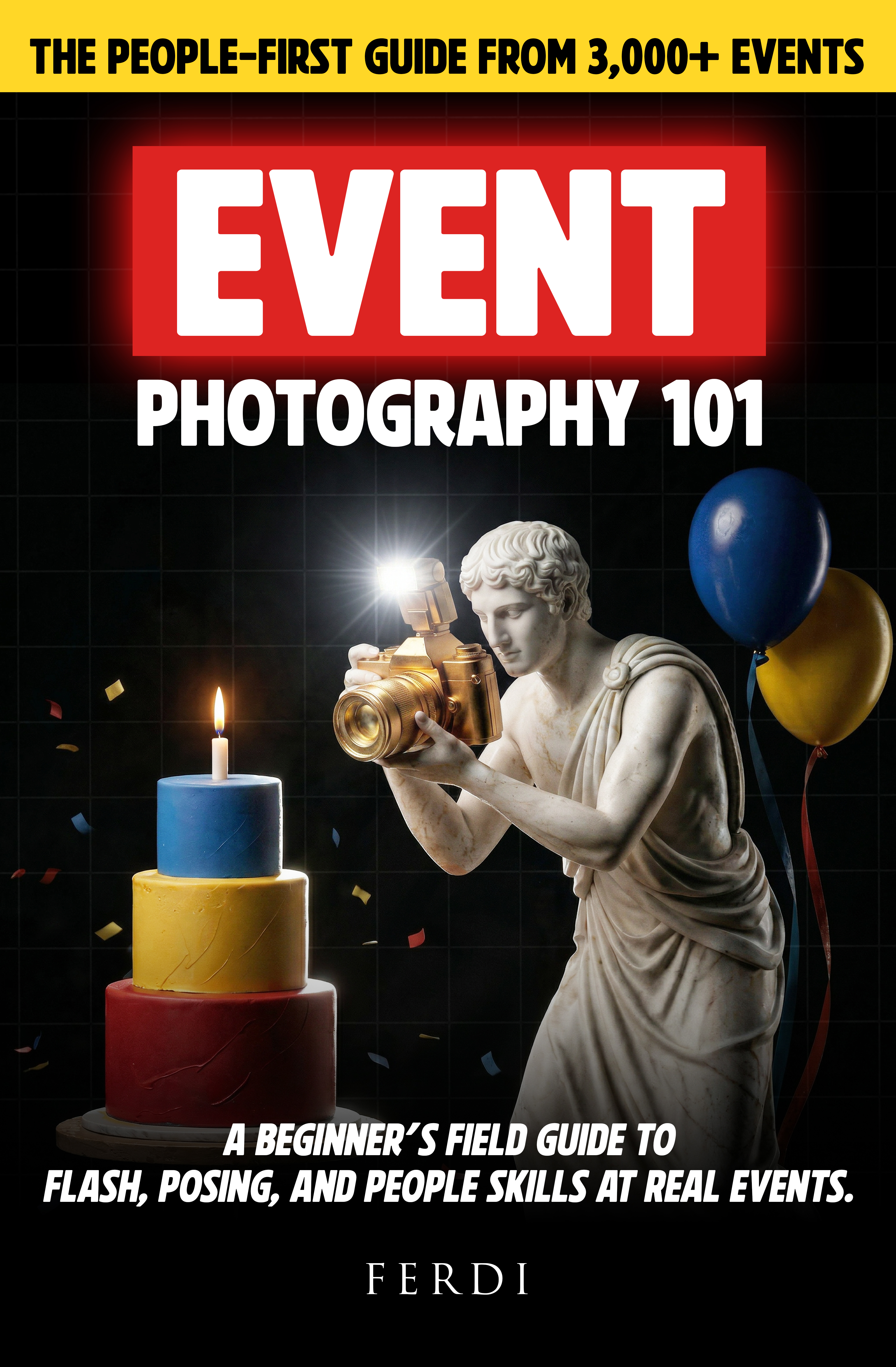
If this guide made the business side feel less foggy, that is the foundation. When you want the fuller working system — pricing structure, contract templates, the client scripts that keep your time protected without making you sound cold, and the delivery workflow with exact discipline at each step — Event Photography 101 turns these principles into a field system. If you are serious about turning photographs into a business that actually pays, the book is the next step. 📘